

Managing high-viscosity and high-solids fluids poses a severe technical challenge in drilling mud and environmental engineering. Traditional centrifugal pumps generate high shear forces, which cause fluid turbulence and accelerate component wear. As a premier representative of positive displacement rotary pumps, the progressive cavity pump utilizes an axial, uniform-push mechanism to deliver an ideal solution for industrial fluid driving.
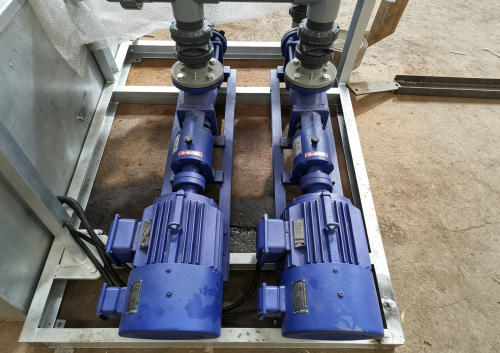 Operating Logic of the Progressive Cavity Pump
The progressive cavity pump relies on the interference fit between a stainless steel rotor and an elastic stator. As the rotor rotates within the stator, it creates sequential cavities that move fluid smoothly along the axis. This physical geometry provides exceptional processing advantages:
- Shear-Free Stable Transport:The fluid maintains low internal velocity and constant volume. This design stabilizes discharge pressure and eliminates turbulence completely.
- Tight Sealing and Separation:The continuous sealing line isolates the inlet from the outlet. This mechanism acts as an integrated valve to prevent backflow during shutdowns.
- Multiphase Handling and Wear Resistance:The flexible stator handles abrasive solids and suspended hard particles easily. Consequently, the progressive cavity pump allows for reliable multiphase transport of liquids, gases, and solids.
Technical Variations of the Progressive Cavity Pump
Industrial fluid systems utilize three main configurations of the progressive cavity pump based on specific loads and control standards: the SWP heavy-duty series, the standard Mono series, and the variable frequency drive (VFD) Mono series.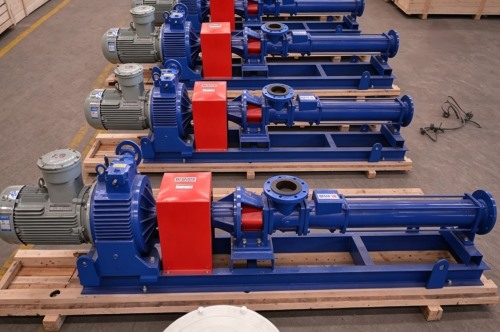
Core Commonalities
All three configurations utilize the single-screw positive displacement principle. They feature standardized 125 mm (5 in) inlets and outlets, which simplifies manifold integration significantly. Furthermore, engineers use high-strength stainless steel for the rotors and design the pump housings to facilitate rapid stator and rotor replacement.
Model Specifics and Technical Differences
- SWP-70: Lightweight Industrial Performance
This model utilizes a 7.5 kW motor, weighs 300 kg, and measures 2175×370×580 mm. It delivers a working pressure of 0.3 MPa and a head of 30 m. Technicians can adjust the flow rate from 2 to 30 m³/h by varying the rotation speed between 80 and 400 rpm. This compact unit provides a cost-effective solution for tight jobsites with low-to-medium displacement requirements. - G70 Standard Mono: High-Pressure Heavyweight
This heavy-duty progressive cavity pumpupgrades to an 11 kW motor, weighs 535 kg, and measures 2930×530×720 mm. It generates a high working pressure of 0.6 MPa and a head of 60 m, enabling long-distance, high-pressure transport. The mechanical gearbox adjusts the displacement from 10 to 40 m³/h within a speed range of 200 to 1000 rpm, making it perfect for stable continuous transfer processes. - G70-1 VFD Mono: Intelligent Feeding Automation
This unit shares identical dimensions (2930×530×720 mm) and weight (535 kg) with the standard G70 model, utilizing the same 11 kW power rating. However, it optimizes operations for a rated speed range of 120–253 rpm, delivering a stable 40 m³/h flow at 0.2 MPa pressure and a 20 m head. This specific progressive cavity pumpacts as the ideal feeding pump for decanter centrifuges. The VFD control panel communicates directly with the centrifuge PLC, automatically slashing pump displacement within milliseconds if the centrifuge torque spikes, preventing plugging and system shutdowns.
Selection Matrix for the Progressive Cavity Pump
In summary, choosing the right configuration depends entirely on your site requirements:
- Select the SWP-70 model if your jobsite faces lifting weight limits and space restrictions.
- Choose the G70 standard Mono configuration if your project demands long-distance pumping or high-pressure discharge.
- Deploy the G70-1 VFD Mono unit if you require an automated feeding pump that synchronizes intelligently with your decanter centrifuge system.