


Managing drilling fluid balance requires an efficient jet mud mixer to formulate new fluids and adjust mud density and viscosity. The system couples mechanical pump velocity with a venturi negative-pressure suction channel. This design ensures that raw powder materials and chemical additives dissolve uniformly into active circulation tanks without forming agglomerates, stabilizing bottom-hole fluid rheology.
System Components of the Jet Mud Mixer
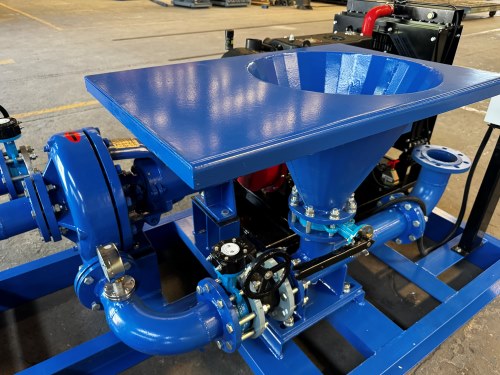
The heavy-duty jet mud mixer integrates three core sub-assemblies on a single skid frame to regulate material distribution:
- Abrasive-Resistant Centrifugal Pump: The system utilizes a 45 kW or 55 kW heavy-duty centrifugal pump as its primary power source. This unit delivers a constant, high-velocity base fluid stream to generate sufficient hydraulic shearing action.
- Venturi Feed Hopper: The jet mud hopper mounts directly above the nozzle assembly. As the high-pressure base fluid passes through the venturi nozzle, it creates a powerful localized vacuum that sucks solid particles into the flow stream automatically.
- Manifold and Valve Assembly: Configuration options include a single-jet system or a double-jet system featuring two pumps and two hoppers. Standardized butterfly or ball valves link the piping networks, allowing operators to cross-connect components or run independent isolation workflows.
 Operational Features of the Jet Mud Mixer
During real-time operations, the jet mud mixer focuses on disaggregating and dispersing multi-phase raw materials within a sealed environment:
- Integrated System Connectivity: The single-jet design integrates the pump and hopper through specialized manifolds. This compact layout minimizes the total equipment footprint and ensures fully enclosed fluid transport, eliminating mud spillages.
- Flexible Modular Configurations: Operators can match and configure the quantities of centrifugal pumps and jet hoppers freely based on site conditions. This flexible design satisfies diverse displacement demands and accommodates tight layout restrictions.
- Venturi and Specialized Nozzle Coupling: The internal flow channel couples a specialized mixing nozzle with the venturi tube geometry. The resulting high-acceleration centrifugal field causes bentonites, barite powder, and polymers to collide violently with the base fluid. This action boosts mixing efficiency and prevents polymer chaining or “fish-eye” defects.
- Simplified Installation and Superior Homogeneity: Compared to traditional vortex mixing units, this jet system simplifies field piping connections and cuts mobilization time. The high-shear fluid driving principle disperses materials thoroughly, producing highly homogeneous drilling muds.
Conclusion
Modern engineering transforms the jet mud mixer from a basic fluid transfer tool into a core control asset for closed-loop fluid management. Ultimately, this dependable mixing technology provides international total contractors with an essential tool to lower operational expenditures while securing stable solids control performance.